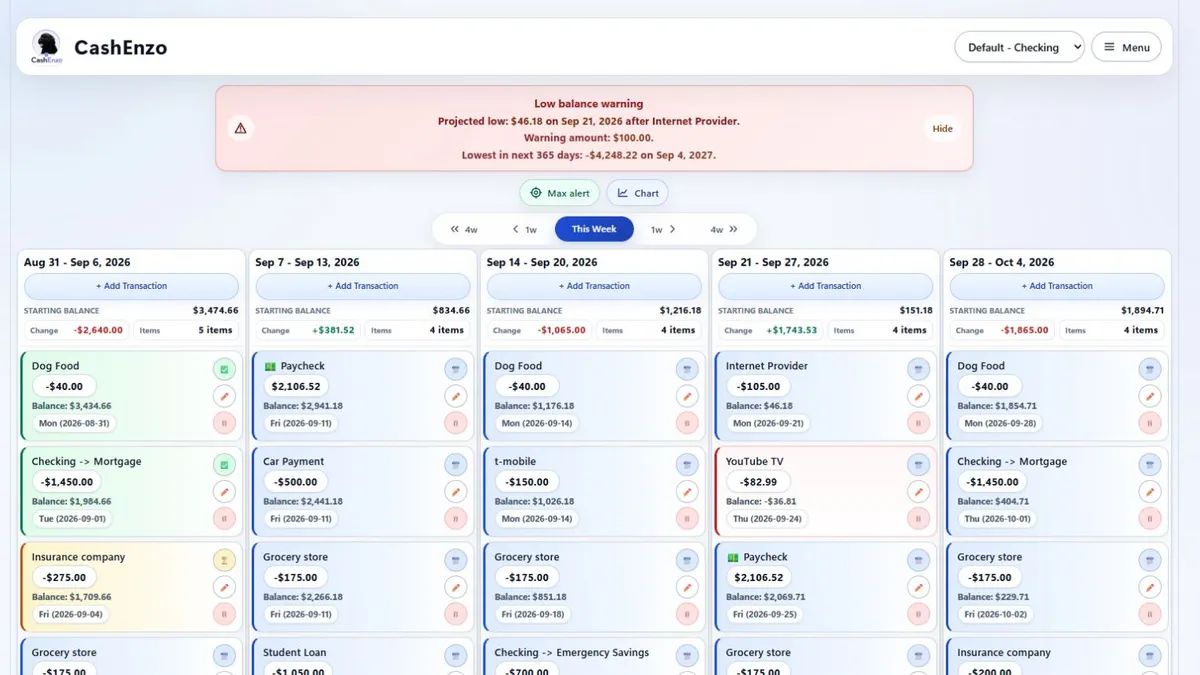
A monthly budget can be accurate and still leave one week feeling tight.
That is the problem I kept coming back to before building CashEnzo. The totals could work for the month, but the order still mattered. A bill might clear on Thursday and the paycheck meant to cover it might not arrive until Friday.
I wanted a clearer way to see that timing while there was still time to respond.
The question I could not answer quickly
Budgeting helped me decide how much I intended to spend. What I still needed was a practical answer to a different question:
What will this account need to cover between today and the next payday?
Answering that meant putting upcoming paydays, bills, card payments, transfers, savings goals, and ordinary expenses on one dated timeline. It also meant following the projected balance after each item instead of waiting for an end-of-month total.
That forward-looking view became the foundation of CashEnzo.
A forecast is an estimate, not a promise
CashEnzo does not claim to predict the future perfectly. Dates change. Bills can be different from their estimates. Transactions sometimes clear earlier or later than expected.
The purpose of a forecast is to make the current plan visible. When something changes, you can update the amount or date and see how the rest of the timeline may change with it.
That earlier view can create useful choices: verify a date, preserve more of the prior paycheck, move an eligible payment, transfer money sooner, or reconsider a flexible purchase. The software does not make the decision. It gives you a clearer view before you make one.
Why CashEnzo does not require a bank password
Many people are comfortable connecting financial tools directly to their banks. Others are not, or simply want another option.
CashEnzo does not connect to your bank and does not ask for your bank password. You can begin manually with one account and only the upcoming activity that matters. If you want to bring in more history, you can import a CSV, QFX, or OFX file as a draft that you review before saving.
That approach asks a little more of the person using the app, but it also keeps them in control of what they provide.
Why CashEnzo is supported by subscriptions
CashEnzo does not show ads or sell customer data.
The business model is intentionally straightforward: customers pay for the product, and we build the product for them. CashEnzo costs $4.99 per month or $49.99 per year.
Eligible new subscribers can try it free for one month. A subscription and payment method are required, and the subscription renews automatically unless canceled.
Start with the next decision
You do not need to build a perfect twelve-month plan on the first day.
Start with one account. Add the next payday, the bills expected before it, and the everyday expenses most likely to affect the balance. Then look for the lowest projected point.
If the month appears comfortable but one particular week does not, that low point is often where the useful conversation begins.
For a closer look at the two planning views, read Cash-Flow Forecasting vs. Budgeting. For a practical weekly routine, see How to Plan Bills Around Payday With a Cash-Flow Calendar.
See how CashEnzo’s forecast works.
Cash-flow forecasts are estimates and may differ from actual account activity. This article is for general educational purposes and is not financial, tax, legal, or accounting advice.