 Blog
You find something you would like to buy. It costs $200, and there is $1,500 in your checking account. That looks comfortable enough. Then you remember that rent comes out tomorrow and payday is still a few days away.
Before you decide, it helps to ask: What would this purchase leave after the other things my money needs to cover?
To estimate how much you can spend before payday, put your expected bills, everyday spending, and incoming money in date order. Find the lowest balance along the way, then allow for the cushion you want to keep. Adding the purchase to that same timeline shows how it changes the picture.
That is a cash-flow forecast: a look ahead at money coming in and going out. You can make one on paper, in a spreadsheet, or with a forecasting tool such as CashEnzo.
Start with what your balance still needs to cover
Choose the account you would use for the purchase. Review what is expected to leave it before the next payday:
- Bills and automatic payments, including subscriptions or annual renewals.
- Credit-card or loan payments that have not left the account yet.
- Groceries, fuel, transportation, and other everyday spending you expect.
- Planned transfers to savings or another account.
Check pending transactions, too. If your starting balance already reflects a payment, subtracting it again would count it twice. If it does not, include that payment in the plan.
Add expected income on the date you expect it to be available. When the amount or timing is uncertain, try a lower amount or a later date and see whether the plan still works.
If you need help laying out the dates, our guide to planning bills around payday walks through building the calendar. Here, we will use that calendar to make one purchase decision.
A $200 purchase with $1,500 in checking
Suppose it is Monday. Your account has $1,500, your next paycheck is expected on Friday, and you want to leave at least $100 untouched as a cushion.
The numbers below are an example, not a customer account. The $100 cushion is simply the choice in this example; your circumstances may call for a different amount.
First, look at the week without the extra purchase:
| Day | Expected activity | Balance afterward |
|---|---|---|
| Monday | Start with $1,500 | $1,500 |
| Tuesday | Rent: −$900 | $600 |
| Wednesday | Utilities: −$150 | $450 |
| Thursday | Groceries and fuel: −$180 | $270 |
| Friday | Paycheck: +$1,600 | $1,870 |
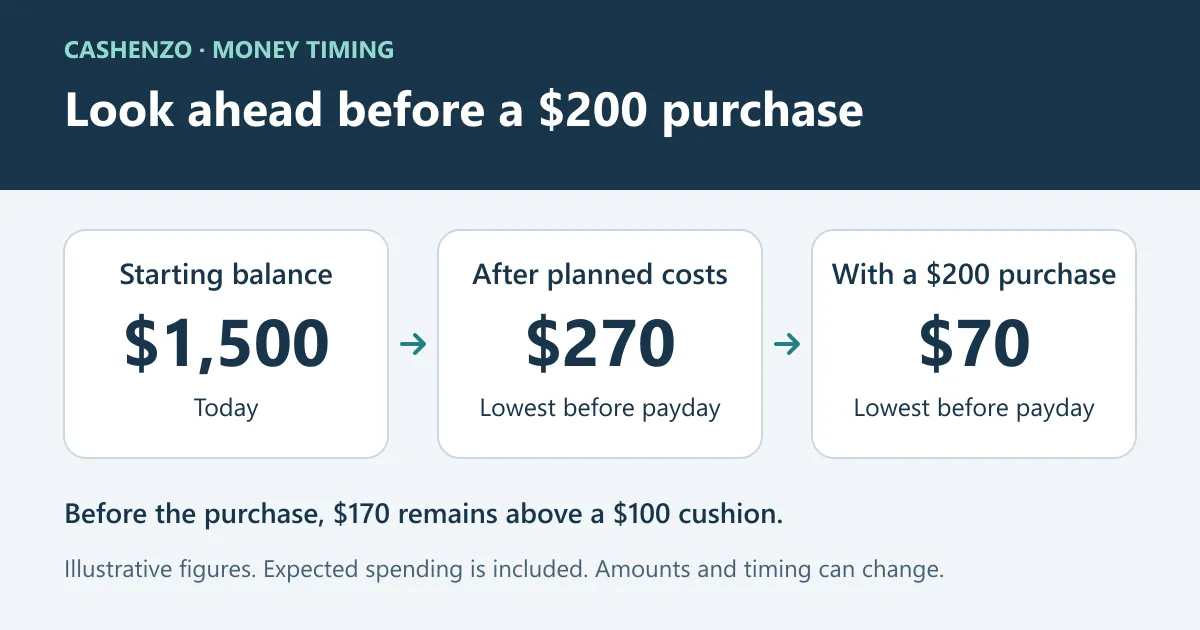
The lowest projected balance is $270, just before payday. With a $100 cushion, that leaves $170 above the cushion for this window.
Now add the $200 purchase on Monday, assuming the money leaves checking that day. Every balance after the purchase is $200 lower. Thursday’s balance becomes $70—which is $30 below the cushion you chose.
The purchase fits inside today’s $1,500 balance. It does not fit inside the room you wanted to leave after this week’s expected spending.
That is useful information before you tap your card. You can decide whether the item matters enough to change the plan, whether a lower-cost option would work, or whether to revisit it after payday.
What changes if you wait until Friday?
If the paycheck arrives as expected and you make the same $200 purchase after it is available, Friday’s projected balance becomes $1,670. The low point earlier in the week stays at $270.
In this example, both purchase dates lead to the same Friday ending balance. Buying on Monday leaves less room during the days before payday.
The Friday example assumes the paycheck is available before the purchase. If that order is uncertain, check what happens when the purchase leaves first, too.
Waiting does not settle the whole affordability question, though. Before buying on Friday, extend the forecast through the following payday. Include the bills, payments, everyday spending, and savings plans that this new paycheck needs to cover.
A purchase can fit between now and Friday and still make the following week tighter than you intended. Looking a little farther ahead helps you see both.
Give the cushion a job
A cushion leaves some room for an estimate to change: groceries cost a little more, a payment clears earlier, or something small was left out.
It is separate from money already assigned to a known bill. If you have an annual insurance payment coming up, put it on the timeline rather than expecting the cushion to cover it. You can read more about how emergency savings fit a cash-flow forecast.
When the projected balance stays above your cushion, the purchase fits the dates and amounts you included. You still get to decide whether it supports your other priorities. A forecast helps you see the choice; it does not make the choice for you.
If the purchase takes the balance below your cushion, check the inputs first. Correct a missing expense or changed date before deciding what to adjust. A smaller purchase or a different purchase date may change the result without disturbing money already committed to bills.
What if you use a credit card?
The date a purchase affects checking may be the later card-payment date. Include its effect on the payment you expect to make, and look far enough ahead to see how that payment fits with other commitments.
Moving the purchase to a card does not remove its cost. If you expect to carry a balance, interest and fees also matter. This checking-account example alone cannot tell you whether borrowing is affordable.
For the cash-flow view, avoid counting the same purchase both as an immediate checking withdrawal and again inside a later card payment.
Try the purchase in your own forecast
CashEnzo’s free Payday Timing Checkup lets you enter a starting balance, next payday, and expected activity, then review the lowest projected balance.
Start with the activity you already expect. Note the lowest balance, add the proposed purchase, and compare. You can also change its date to see how the timing affects the result.
If a purchase and paycheck share a date, the Checkup lets you compare money going out first with money coming in first. Choose the order that matches the situation you want to review.
The Checkup runs in your browser without an account or bank connection. The financial details you enter are not sent to CashEnzo.
CashEnzo is the product behind this blog. If you want to keep a forecast current over a longer period, explore CashEnzo’s forecasting features.
Before the next purchase, try this short check:
- Confirm the starting balance and what it already includes.
- Include the bills and everyday spending coming next.
- Add the purchase on the date it will affect the account.
- Find the lowest projected balance and compare it with your cushion.
You do not need perfect predictions to make a more informed choice. A current view of the next few dates can help you see what your money needs to do before you spend it.
For another paper-based approach, the Consumer Financial Protection Bureau’s cash-flow budget worksheet includes everyday expenses, bills, and savings alongside expected income.
This article is for general educational purposes and is not financial, tax, legal, or accounting advice. Forecasts are estimates; actual amounts and timing can change.